Telemetry analyzer

Your Tesla footage,
with everything it
was hiding.

Every Sentry and Dashcam clip carries the data your car recorded while it filmed. Dashmetrics reads it and renders it back onto the video: speed, steering, autopilot state, G‑force, GPS position, synced frame by frame.

Download on the App Store Get it on Google PlayComing soon

Free to try · No account · Nothing leaves your phone

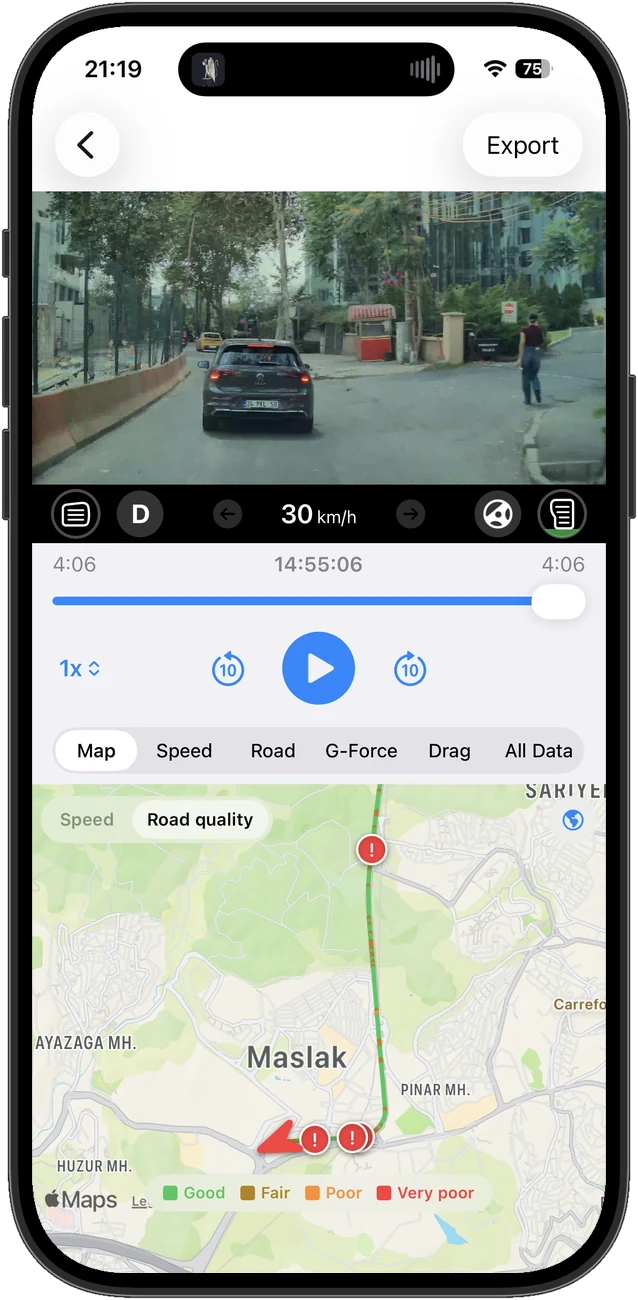
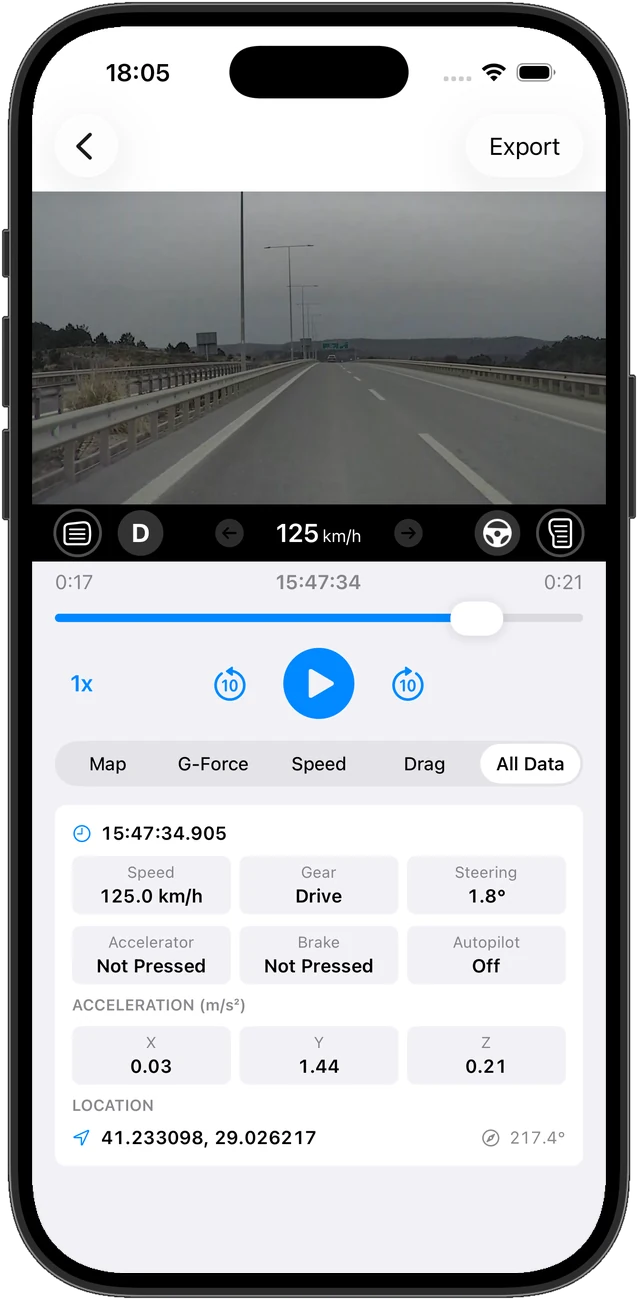
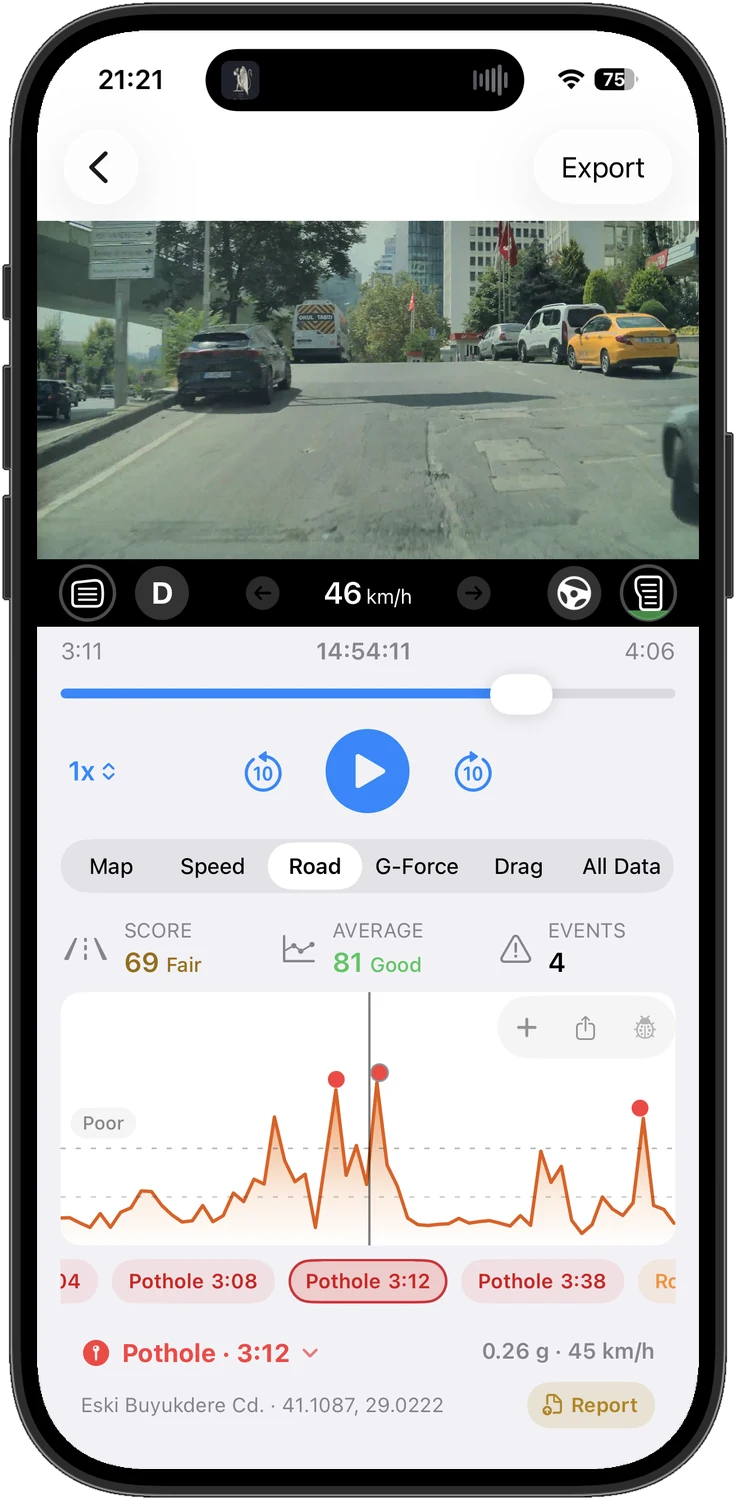
Route on a map, coloured by road quality Full telemetry readout for a single frame Dashmetrics Road tab showing a road score of 69 and four detected events
Sample drive · Sarıyer, İstanbul Score 69 Fair Events 4
Good Fair Poor Very poor Scored from vertical acceleration
6Camera angles
4KMax export
0‑100Timed automatically
100%On device
What it does

The data was already there.

Your car writes telemetry alongside every clip it saves. Dashmetrics decodes it, lines it up with the footage and gives you something you can actually read.

Speed, gear, steering, pedals, acceleration and location for one frame
Full telemetry

Every recorded value, frame by frame

Scrub to any moment and read what the car was doing: speed, gear, steering angle, pedal input, autopilot state, three-axis acceleration and the exact coordinates. Export the whole log as CSV when you need it elsewhere.

SpeedSteeringAutopilotPedalsCSV export
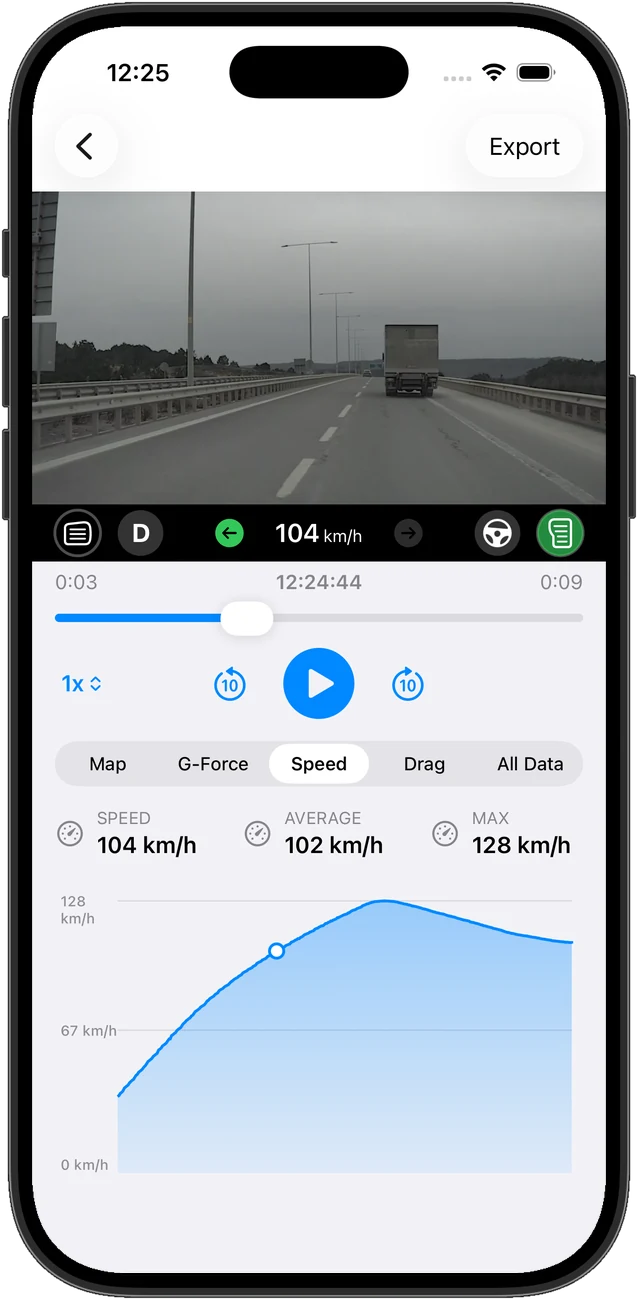
Speed graph with average and top speed
Speed & G-force

See the shape of the drive

An interactive speed curve with the average and the top of the run, plus lateral and longitudinal G‑force as you go through every corner.

Speed curveG-force
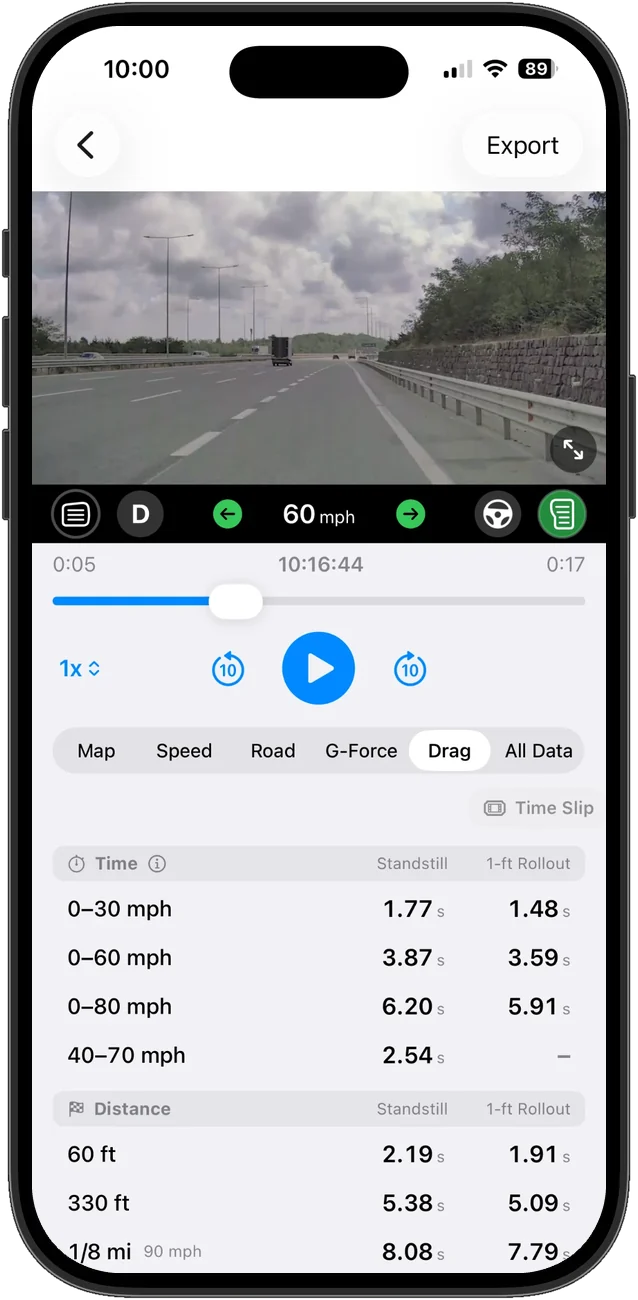
Drag tab listing the acceleration runs found in a clip, each with its time
Drag timer

Your real 0‑100, found on its own

Acceleration runs are detected in the telemetry without you marking anything. Every 0‑50, 0‑100, 0‑120 and 80‑120 km/h pull in the clip is listed with its time and where it happened — or 0‑30, 0‑60, 0‑80 and 40‑70 mph if that is how you read a speedo.

The same launch is measured against the strip's distance marks too: 60 ft, 330 ft, the eighth, 1000 ft and the quarter mile, with a trap speed where the strip gives you one, or 100 to 1000 m on metric. Both timing conventions are there — a true standstill start, or the 1‑ft rollout a drag strip actually measures — and any of it can fill in live on the exported video.

0-100 km/h & 0-60 mph60 ft → 1/4 miTrap speedRolloutLive HUD splits
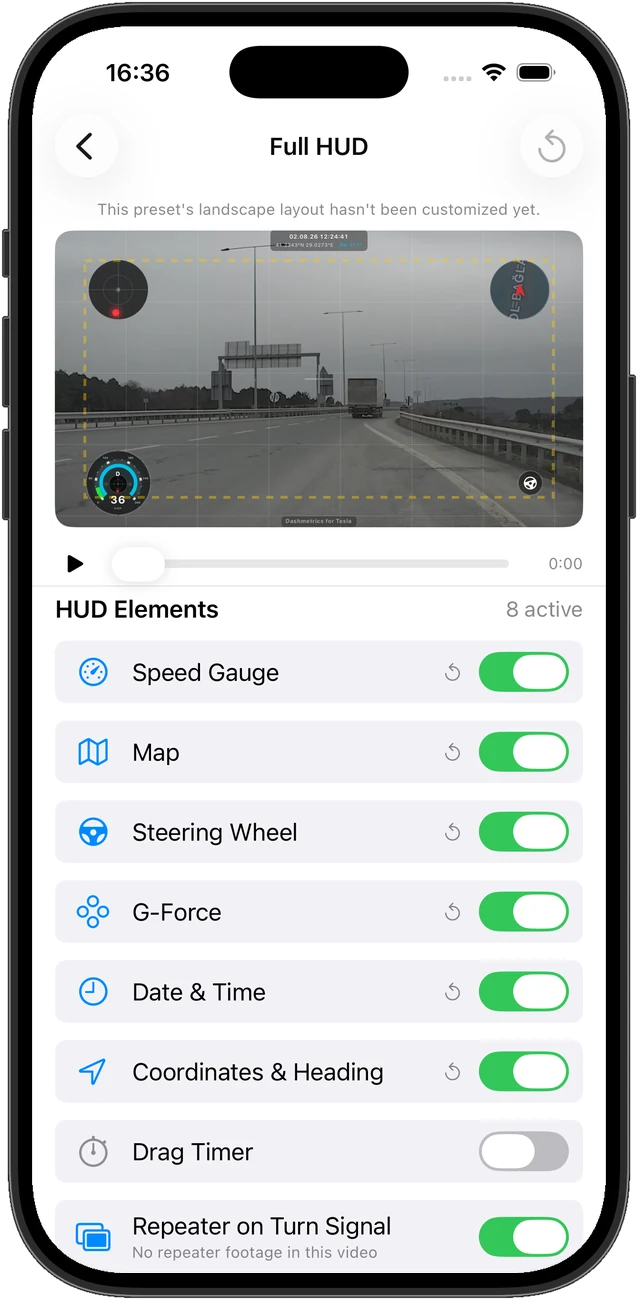
HUD element editor with toggles for each overlay element
Custom HUD

Build the overlay you want

Speed gauge, minimap, steering wheel, G‑force meter, coordinates, timestamp, drag timer and custom text. Turn each one on or off, place it where you want it and preview the whole thing before a single frame is rendered.

PresetsDrag to placeLive preview
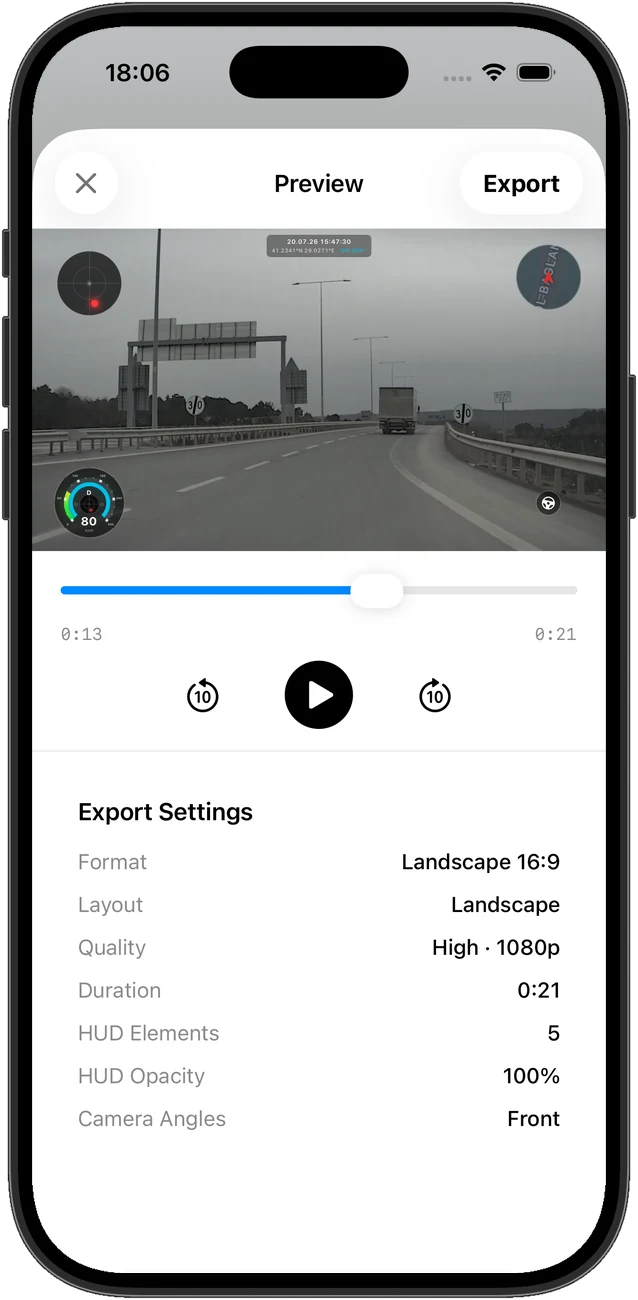
Export preview showing landscape 16:9 settings
Export

Landscape for YouTube, portrait for everywhere else

Trim to the moment, pick 16:9 or 9:16 and render up to 4K. The layout adapts to the format instead of cropping your overlay off the edge, and file size is estimated before you commit.

With more than one camera in the clip you also choose how they land. Side by side in a grid, or one by one — the same moment played through again for each camera, full screen, every one with its own trim and its own place in the running order.

16:99:16Up to 4KTrim & cropOne by one
See it running

Recorded on device,
nothing sped up.

Drop in a clip

Straight from Files or Photos, every camera angle detected at once.

Telemetry on every frame

Speed, gear, steering and pedals, lined up with the footage.

Map, G-force, speed

The same drive from every angle, switchable in one tap.

The raw log

Every sample in a table, exportable to CSV.

Building the export

Trim, choose the HUD, preview it, then render in 16:9 or 9:16.

Road quality export

0:25

Footage on top, the quality trace and every impact underneath.

Drag timer export

0:13

Splits filling in live as the car pulls: 0-50, 0-100, 0-120 and 80-120.

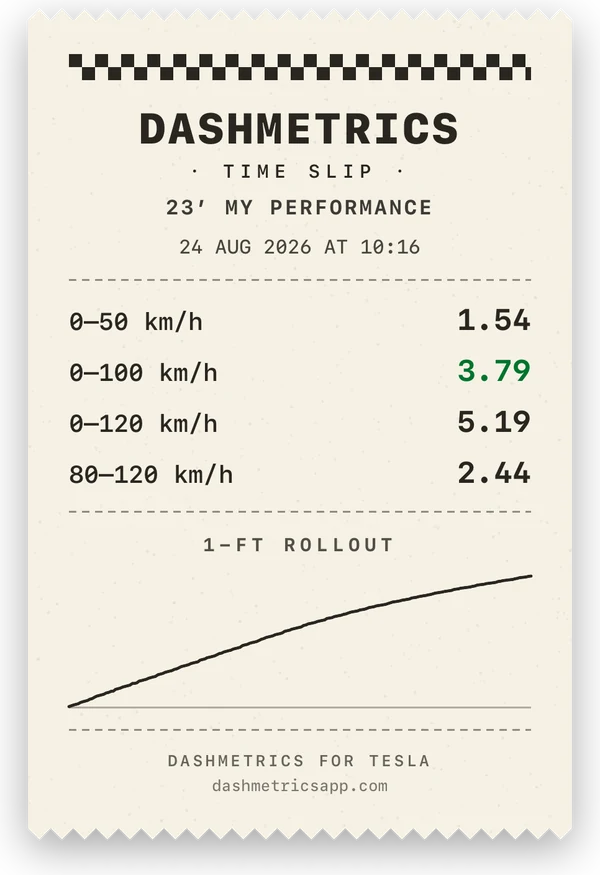
Time slipNEW

Leave with a ticket.

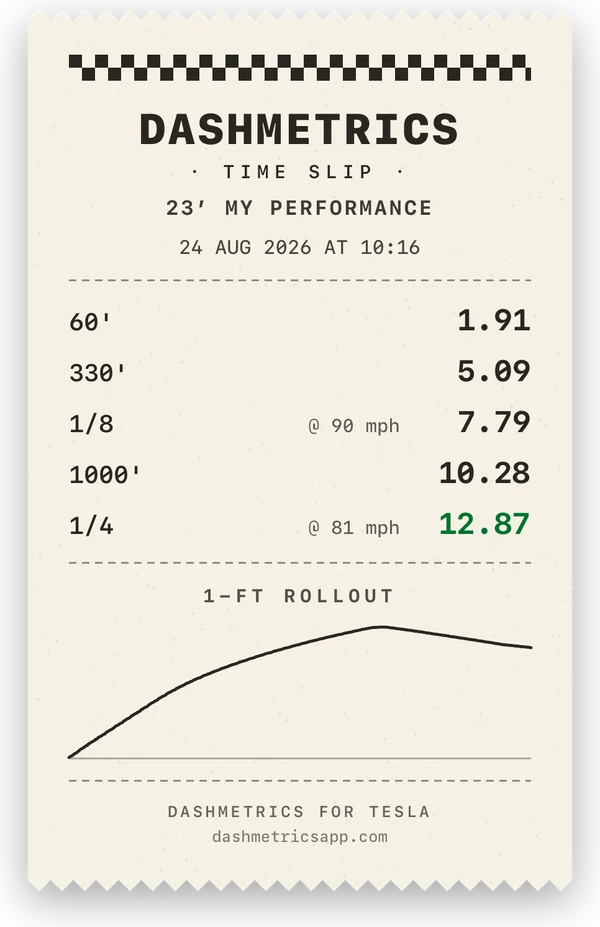
The quickest pull in your clip, printed the way a drag strip prints it — as an image made to be shared.

  • Time or distance. Your speed ranges, or the strip from 60 ft to the quarter mile with its trap speeds.
  • One pass. Every row and the curve come from the same launch.
  • Standstill or 1‑ft rollout, stamped on the ticket. Plus a line of your own for the car or the plate.
Trap speedkm/h or mphShare or save
Time slip printed by Dashmetrics: 0 to 50 km/h in 1.54 seconds, 0 to 100 in 3.79, 0 to 120 in 5.19 and 80 to 120 in 2.44, measured with 1 foot rollout
Time
Distance slip printed by Dashmetrics: 60 feet in 1.91 seconds, 330 feet in 5.09, the eighth mile in 7.79 at 90 mph, 1000 feet in 10.28 and the quarter mile in 12.87 at 81 mph
Distance
Road quality analysis

Score the road
you drove on.

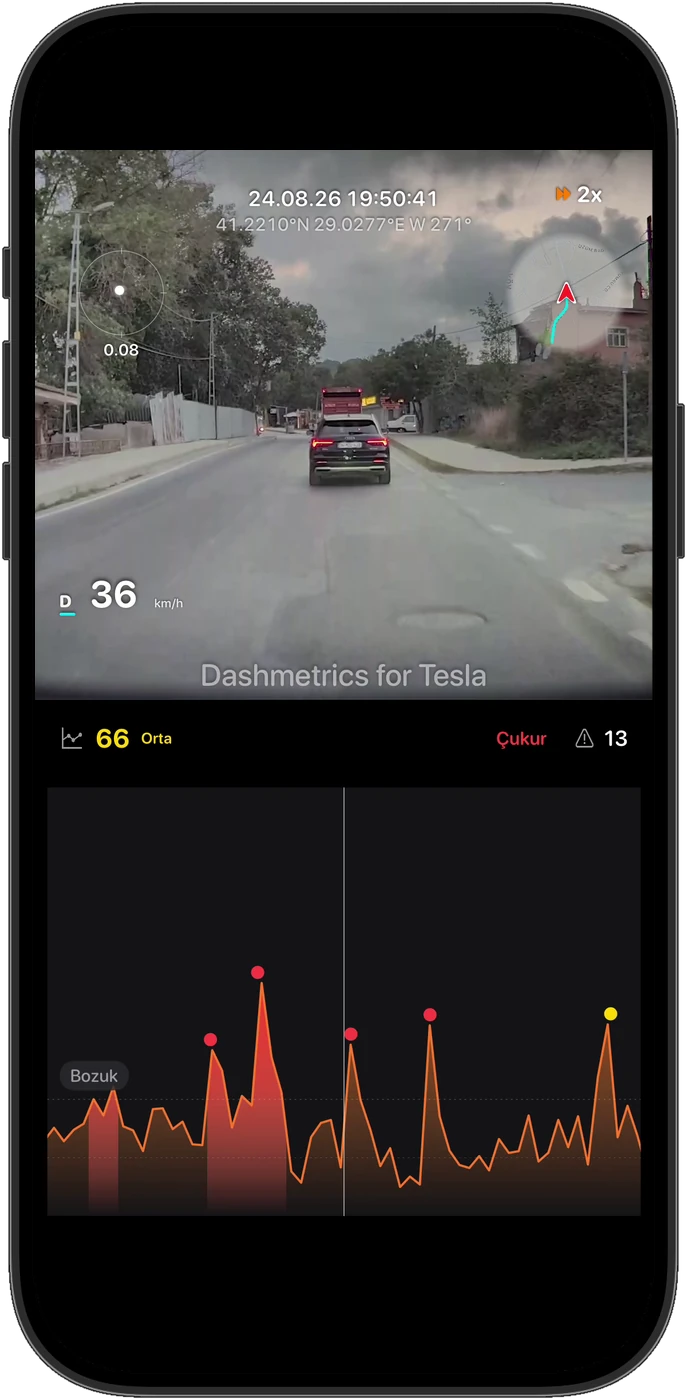
Vertical acceleration already tells you how rough the pavement was. Dashmetrics turns it into a score, pins on a map and evidence you can send to someone who can fix it.

Automatic road score

Every clip is scored from the telemetry it already carries. Nothing to mount, nothing to calibrate.

Potholes and speed bumps

Impacts are pinned on the chart and the map with the time, the speed and the coordinates. Add one by hand or correct the type when the detector gets it wrong.

Rough stretches

Sustained broken pavement is marked as a range rather than a point: where it starts, how far it runs and how bad it gets.

Evidence reports

Share a photo, a video or a PDF of any finding with its address, coordinates and time, or export the whole drive as one report.

Vertical export with dashcam footage above a live road quality chart
How it works

Three steps, one phone.

STEP 01

Bring the clip in

Copy a Sentry or Dashcam recording from your car's USB drive to your phone, or save one remotely from the Tesla app. Point Dashmetrics at the whole event folder and every camera angle inside it is detected at once.

FolderFilesPhotos
STEP 02

Read the drive

Follow the route on the map, scrub the speed and G‑force charts, check the road score and jump between camera angles without re-processing anything.

STEP 03

Export what matters

Trim to the moment, choose your HUD and format, and render a clip you can post, send to your insurer or attach to a complaint.

No clip on your phone yet? Start with one of ours.

Three real recordings ship with the app and open through exactly the same import path as your own: a full‑throttle launch for the Drag tab and the time slip, a minute of city streets for the map, speed and road quality, and a multi‑camera event for split‑view playback and the one‑by‑one export.

Every paid feature is unlocked while a sample is loaded, so you can build a HUD and render a finished export end to end before you decide anything — useful too when your own car’s firmware turns out to be too old to write telemetry.

Step 01, in detail · Three ways to bring a clip in
Recommended · Folder

Pick a whole event folder

On the drive the clips live in TeslaCam, split into RecentClips, SavedClips and SentryClips, and every saved event gets its own folder. Inside it the car writes the footage in one‑minute segments — one file per camera, per minute. A five‑minute event across six cameras is thirty separate files.

Which is exactly why this is the route to use: hand over the folder and all of it is ordered, matched by angle and stitched into one continuous timeline.

Files

Pick individual clips

Straight from the Files app, or from the drive itself: a USB‑A to USB‑C adapter plugs it into the iPhone and Dashmetrics reads the clips in place, with no copying step first. Moving the folder to the phone through Files works just as well.

Keep the file names Tesla gave them — the camera angle is read from the name, so a renamed file loses its position in the layout.

Photos

Import from your library

The route for clips you saved remotely through the Tesla app, or anything already in Photos. Select every piece of a moment at once — the 30‑second saves the Tesla app makes are re-ordered and stitched back into one timeline, overlaps included.

The telemetry survives as long as the video reaches the library untouched.

A clip that has been through WhatsApp has no telemetry left. The data rides inside the original file the car wrote. Messaging apps and social platforms — WhatsApp, Telegram, Messenger, Instagram, and anything else that re‑compresses a video before sending it — hand over a re‑encoded copy, and the telemetry does not survive that. The same goes for a clip re-exported by an editing app or run through a converter. Dashmetrics will still play it, but there is nothing left to read.

Move the original file instead: the folder off the USB drive, the file itself through Files or AirDrop, or the clip saved to Photos by the Tesla app. All four keep it intact.

Tesla software 2026.20NEW

Recordings encrypted?
Four ways in.

Since software update 2026.20, Tesla encrypts Dashcam and Sentry recordings on the USB drive by default. An encrypted file cannot be opened by Dashmetrics — or by any other player — directly. Four ways to get a clip that opens in full, from the quickest one‑off to the one that settles it for good.

OPTION 01 · ONE CLIP

Tap the padlock in the car

Open the Dashcam Viewer on the car's screen, find the clip and tap the padlock on it. Tesla's own release note puts it plainly: “To decrypt clips, tap the padlock icon in the Dashcam app or visit dashcam.tesla.com.”

Clip by clip, straight from the driver's seat, with nothing else to set up. The quickest route when there is one moment you actually care about.

OPTION 02 · EVERYTHING FROM NOW ON

Turn encryption off

Open Controls → Safety → Encrypt Dashcam Recordings on the car's screen and switch it off.

Everything the car records from that point on is saved unencrypted, exactly as before, and opens straight away. Clips already on the drive are not touched, so pair this with one of the other options for those.

OPTION 03 · A WHOLE DRIVE'S WORTH

Decrypt online

Plug the USB drive into a computer, go to dashcam.tesla.com and sign in with your Tesla account. The keys are fetched for your account and decryption happens locally in your browser, then you save the readable files.

The one to use for recordings already sitting on the drive, in bulk.

OPTION 04 · NO USB AT ALL

Use the Tesla app

Browse your Dashcam and Sentry clips remotely in the Tesla app and save them to your phone. They arrive already decrypted — no setting to change, no USB drive to unplug.

Two limits worth knowing: it saves one camera at a time, and at most 30 seconds per save. So take as many 30‑second pieces as the moment needs, angle by angle, overlaps and all — import them together and Dashmetrics puts them back in order and joins them seamlessly.

Then import as usual

Unencrypted and decrypted clips both work in full here, telemetry included. Dashmetrics never asks for your Tesla account and never sends a clip anywhere — decryption is something the car or Tesla's own site does, before the file ever reaches the app.

Questions

Before you download.

Which files does Dashmetrics work with?

Sentry Mode and Dashcam recordings that your Tesla saves to its USB drive, and the same clips saved to your phone remotely through the Tesla app. Copy a recording folder to your phone and open it in the app. Every camera angle in the folder is detected together, so you can switch between them without re-processing anything. Recordings the car has encrypted need one extra step first, described below.

My Tesla encrypts its recordings. Can Dashmetrics still read them?

Not while they are encrypted. Since software update 2026.20 Tesla encrypts Dashcam and Sentry recordings by default, and an encrypted file cannot be opened by Dashmetrics or any other player. There are four ways round it. Tap the padlock on a clip in the car's own Dashcam Viewer, which decrypts that clip where it sits — the quickest route for a single moment. Switch the setting off under Controls → Safety → Encrypt Dashcam Recordings, and everything recorded from then on is saved unencrypted. Decrypt in bulk at dashcam.tesla.com, where you sign in with your Tesla account and the files are decrypted locally in your browser for you to save. Or save clips to your phone through the Tesla app, which hands them over already decrypted. Once a clip is unencrypted it works in full here, telemetry included.

The Tesla app only saves 30 seconds at a time. Is that a problem?

No. The Tesla app saves one camera at a time and caps each save at 30 seconds, so a longer moment comes out as several pieces, and a second angle means going round again. Save as many pieces as you need — you do not have to line them up or trim the overlaps — then import them together. Dashmetrics reads the timing out of each file, puts them back in order, matches them by camera and joins them into one seamless timeline.

Where are the clips on the USB drive?

In the TeslaCam folder, split into RecentClips, SavedClips and SentryClips, with every saved event in a folder of its own. Inside that folder the recording is cut into one-minute segments, one file per camera per minute, so a five-minute event across six cameras is thirty files rather than six. That is why handing over the whole folder beats picking files by hand: Dashmetrics orders the segments, matches them by angle and joins them into one timeline. Leave the file names as Tesla wrote them — the camera angle is read from the name, so a renamed file cannot be placed correctly in the layout.

How do I get a clip into the app?

Three ways. Pick a whole event folder, which is the one we recommend, because the recording is split into one-minute segments per camera and the folder route puts them all back together automatically. Pick individual files from the Files app, or straight off the USB drive: with a USB-A to USB-C adapter the drive plugs into the iPhone and the clips can be read in place without copying them first. Or import from Photos, which is the route for clips saved remotely through the Tesla app. Whichever you use, it has to be the original file the car wrote.

A clip someone sent me over WhatsApp shows no telemetry. Why?

Because it is no longer the file the car wrote. The telemetry rides inside the original recording, and messaging apps and social platforms — WhatsApp, Telegram, Messenger, Instagram and the rest — re-compress a video before sending it. What arrives is a re-encoded copy with the data gone, and no app can recover it. The same applies to a clip re-exported by a video editor or run through a converter. Dashmetrics will still play such a file, there is simply nothing left to read. To keep the telemetry, move the original: the event folder off the USB drive, the file itself through Files or AirDrop, or the clip saved to Photos by the Tesla app.

Does it upload my footage anywhere?

No. Decoding, analysis and rendering all happen on the device. There is no account to create, no upload step and no server holding your clips. The app does not need a network connection to do any of the work.

What telemetry can it show?

Speed, gear, steering angle, accelerator and brake input, autopilot state, three-axis acceleration, GPS coordinates and heading, for any frame of the clip. It also derives a speed curve, G-force readings, acceleration times and a road quality score, and can export the whole log as CSV.

How does road quality scoring work?

The vertical acceleration already recorded alongside the footage indicates how rough the pavement was. Dashmetrics turns that into a score for the clip, pins individual impacts such as potholes and speed bumps with the time, speed and coordinates, and marks sustained broken pavement as a range rather than a single point. Nothing needs to be mounted or calibrated.

What can I export?

A video with your chosen HUD overlay in 16:9 or 9:16, up to 4K, and with several cameras either side by side in a grid or one after another full screen. From an acceleration run you can export a time slip: a drag-strip ticket as an image, in a time or a distance version. From the road quality analysis you can export a single finding — a pothole, a speed bump or a rough stretch — as a photo, a video or a PDF report carrying its address, coordinates and time, or the whole drive's findings as GeoJSON and CSV. The raw telemetry log exports as CSV too.

What is the time slip?

A shareable image of one acceleration run, laid out like the ticket a drag strip hands you, in two versions of the same pass: a time slip listing your speed ranges, and a distance slip listing the strip's marks from 60 ft to the quarter mile with their trap speeds. Every line comes from the same launch, the quickest one in the clip, and the curve underneath is that run. It states whether it was measured from a standstill or with a one-foot rollout, and can carry a line of your own text for the car or its plate — text that stays on your phone and only leaves it inside the image you share.

Can I try it without a Tesla clip?

Yes. Three real recordings ship with the app: a full-throttle launch, a minute of city driving and a multi-camera event. They open through the same import path as your own footage, and every paid feature is unlocked while one is loaded, so you can explore the telemetry, build a HUD and render a complete export before deciding anything. It is also the answer when a car turns out to be too old to write telemetry alongside its recordings.

Does it work in mph?

Yes. Switch the app to imperial and speeds, the HUD gauge, the acceleration ranges and the drag distance marks all follow: 0-30, 0-60, 0-80 and 40-70 mph, and 60 ft through to the quarter mile. On metric you get the km/h ranges and the 100, 200, 400 and 1000 m marks. The two families never mix, since a quarter-mile time means little to a driver who thinks in metres.

Is there an Android version?

An Android version is in development. The iOS app is on the App Store now.

How much does it cost?

Free to try. You can browse your clips, explore the telemetry and preview overlays without paying. A paid upgrade removes the watermark and unlocks full quality exports, every HUD template and road reports.


Your footage stays on your phone

Decoding, analysis and rendering all happen on device. There is no account to create, no upload step and no server holding your clips. Dashmetrics does not need a network connection to do any of the work.

Free to try

See your drive like never before.

Browse your clips, explore the telemetry and preview overlays for free. Upgrade whenever you want watermark-free exports in full quality.

Download on the App Store Get it on Google PlayComing soon